
The Problem Likely Isn't Where You Think It Is
10 March 2026
A few weeks ago I moved a storage cubby. That's it. That's the post.
One cubby, from where it was to the spot below; the empty project bags I grab every time I head out to teach went from "annoying to reach"1 to "obviously available." I didn't reorganize my whole studio. I didn't buy new furniture. I moved one thing.2
I spent probably six months mildly frustrated every time I packed up for a knitting group or lesson. Months of being frustrated by a small, seconds-long inefficiency that created a low-grade background hum of "this isn't working." The fix took five minutes.
That's a pressure point.
Why We Misdiagnose Our Own Problems
When something feels off in a business, the instinct is to look at everything. Or to ignore it entirely and assume the problem is you. The website needs a full redesign. The whole filing system is broken. The scheduling process is a disaster, so we need a new app. We jump to the big fix because the friction feels big. It's overwhelming and you just want it fixed. Yesterday.
But friction is sneaky. It's a bit like a leaky pipe: the issue isn't always where the water is dripping.3
In my work with solo creative businesses (and in my own), the most common thing I see is someone convinced they need to make a drastic switch and change tools entirely. Sometimes that's true. More often, what they actually need is better communication among the tools they're already using. Or someone thinks their website is the problem, when really three pages are doing all the heavy lifting and the rest is just noise.
The whole system isn't broken. One part of it is rubbing wrong. And because everything is connected, that one spot creates drag everywhere else.
What a Pressure Point Looks Like
A pressure point is where small friction creates outsized drag. It's not always the most dramatic problem. Sometimes it's:
- The folder you can never find, so files pile up on your desktop until they multiply
- The email template you haven't updated, so you rewrite the same message from scratch every time
- The one step in your process that requires you to manually copy something from one place to another
- The page on your site that visitors keep landing on but doesn't answer the question they actually have
- The mailing list you haven't cleaned in two years, quietly inflating your monthly bill while you price out a platform migration you don't actually need
You probably know what yours is. It's the thing that makes you sigh every time you do it.
How to Find Yours
Follow the sigh. For one week, note the moments when you feel a small drop in energy. That little ugh. The slight hesitation before a task — or when you pick up your phone for a social media hit instead of doing the thing. That's friction. Write it down.
For me, recently, it was my notebooks. My work has changed, and so has what I need my logbook to do. I felt obligated to keep using the notebooks I sell as my daily log, but they weren't the right fit anymore. So I was carrying more than I needed.4
Look for the workaround. If you've MacGyvered a workaround, that's resourceful; but it's a pressure point in disguise. Workarounds mean you solved a problem once without fixing the underlying issue. What do you approach sideways instead of head-on?
My workaround for the notebook situation is a little embarrassing to admit: I was writing things on sticky notes and sticking them to the cover of my notebook. I knew it wasn't working. I was just avoiding the decision.
Ask what you avoid. What task do you put off longer than it deserves? Often it's not that the task is hard. It's that getting to it has too many small irritants in the way.
In this case, all I had to do was accept that my work had changed and adapt to it. Set aside the larger A5 notebook, insert a new one for log notes. Done.
The Fix Is Usually Smaller Than You Think
Once you find what's actually creating pressure, the fix is rarely the overhaul you were dreading. It's more likely:
- Moving something to where you actually use it
- Writing down the steps you do from memory so you have a checklist (and so future-you doesn't have to reconstruct it)
- Making a keyboard shortcut or text expansion for what you type constantly
- Redirecting one URL so it goes somewhere useful
- Cleaning the zombies off a mailing list so your monthly cost reflects your actual audience, not years of accumulated addresses
You don't need a new system. You need to fix the one spot where the current system is catching.
This is what I mean by small changes. I'm not asking you to think small, and you won't be settling. I'm asking you to solve the actual problem, not the imagined one. The cubby you can now look into instead of reaching into blindly. The one page rewrite that makes your site make sense again.
Start small. See what else loosens up.
If you've got a pressure point that's been bugging you and you're not sure whether it's fixable or actually something bigger, book a consultation. Sometimes it takes working with someone outside your own head to see it clearly.
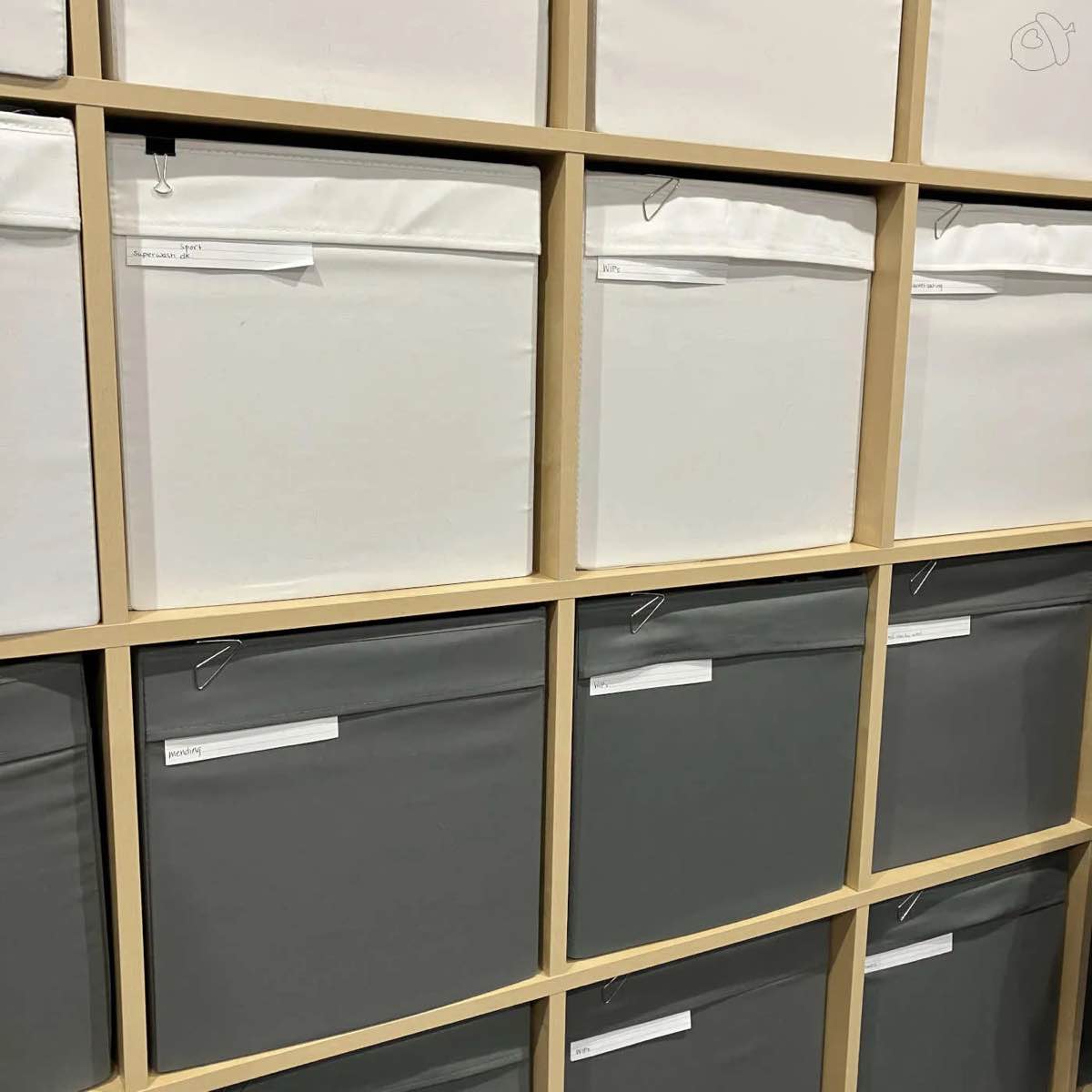
- In reality: the bin was above eye level, so I was reaching up and in, pulling bags out by feel because getting the step stool out took even more time. What's in that just-above-eye-level spot now? The wool batting fill I use every so often. When I need it, I'm intentional about it — getting out the step stool is part of the process, not friction, because it means I'm at the stuffing stage of a project.
- Well, technically I swapped two bins. The top two levels are white, the bottom are grey, so the contents had to move to keep the visual consistent. Still, it took only minutes.
- While my grandfather ran a successful plumbing supply store, I was once likened to House, M.D. (minus the pain killers.)
- I started using this new-for-me notebook system about a year ago. I haven't yet figured out if I want to carry it in the shop, but I still love and highly recommend what I have in stock. It just doesn't fit my current needs right now, so I'm adapting.